Introduction
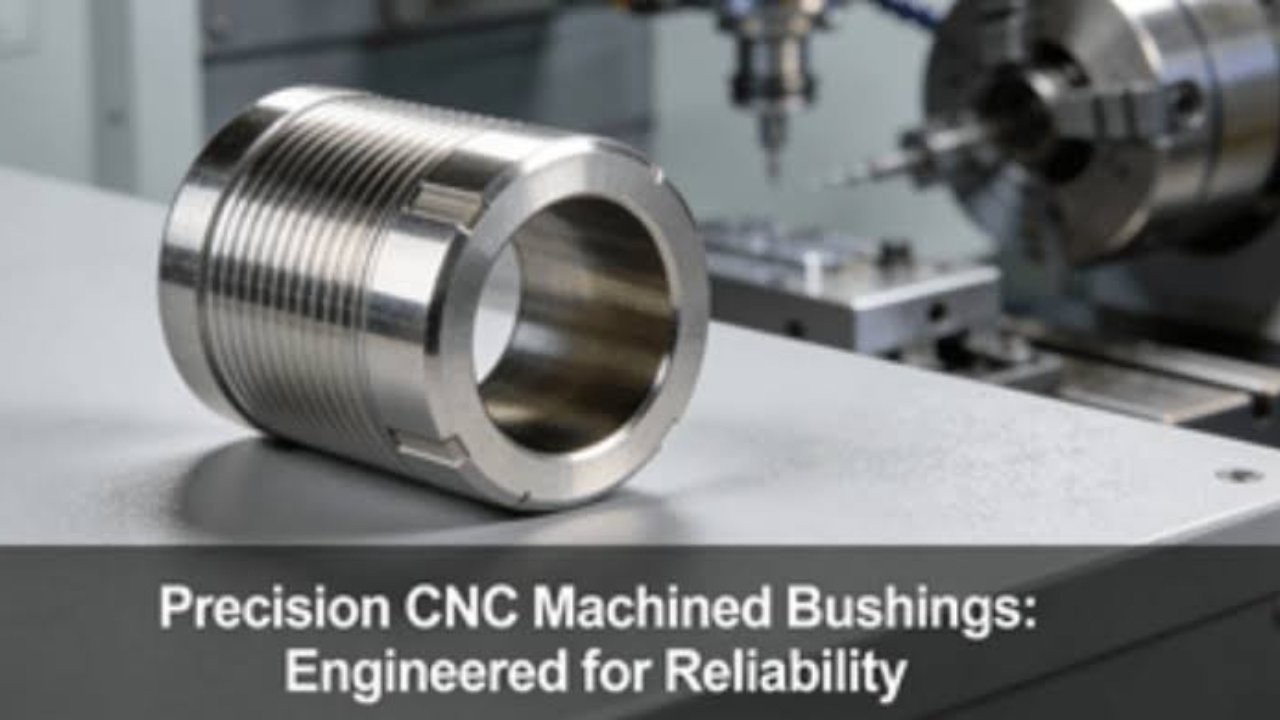
In the market for manufacturing high-end equipment in the year 2026, Custom Bushing Manufacturers can face the problems of assembly interference, unusual wear, and even equipment malfunctioning because of a lack of precision in Custom Bushings. Even minor discrepancies in the size of these components can disrupt the whole manufacturing line, thus causing heavy losses.The reason why this happens is not related to the design of parts but rather to the manufacturing processes. Conventional methods for making the parts cannot maintain micron-level accuracy affected by heat deformation and tool wear. Lack of SPC for mass production also causes inconsistency between batches.
This paper aims to show how the new era of CNC Machining Services solves the problems with the precision and consistency of the bushing production. To do this, one must consider several key questions.
Why Does Bushing Precision Directly Determine the Operational Cost of Heavy-Duty Equipment?
Bushings are important components in heavy machinery, serving as an essential source of friction. The precision with which the bushing is made, including roundness, cylindricity, and diameter, impacts equipment vibrations, sound level, energy use, and life cycle. Even minor defects, on a scale of just a few micrometers, can disturb the intended lubricating layer, causing friction, heating up, and premature wear-and-tear that result in expensive and unnecessary downtime, higher maintenance fees, and expensive replacement parts, resulting in huge TCO.
The way out of this is to go beyond dimensional testing into Statistical Process Control. In order to accomplish this, some top Custom Bushing Manufacturers work together with precision cnc machining manufacturers that assure uniformity of ±0.005mm throughout the manufacturing process. This way, not only will the bushing operate reliably, but its behavior is going to be predictable enough for precise estimations of costs..
What Are the Distinct CNC Machining Challenges for Custom Steel and Bronze Bushings?
Custom Steel Bushings & Custom Bronze Bushings pose entirely different challenges when it comes to CNC Machining For Custom Bushings.
Cutting Hardened Custom Steel Bushings
- Tool Wear and Work Hardening
Steels are relatively hard materials that contribute to accelerated wear and work hardening. This calls for hardened, coated tool bits and application of coolant under high pressure. - Avoiding Distortion in Thin Walls
Materials such as custom steel bushings that have slender walls are highly likely to suffer from distortion due to stress. This problem requires proper machining sequence through stress relief machining process to achieve the desired shape.
Coping with the Soft and Gummy Nature of Bronze
On the other hand, Custom Bronze Bushings are soft and gummy, thus leading to formation of built-up edge on the tool surface. This results into low tolerances and poor surface finish. Proper machining requires sharpened polished cutting edges at higher speeds and low feed rate.
What Extreme CNC Technology Demands Do Custom Gear Bushings in Aerospace Impose?
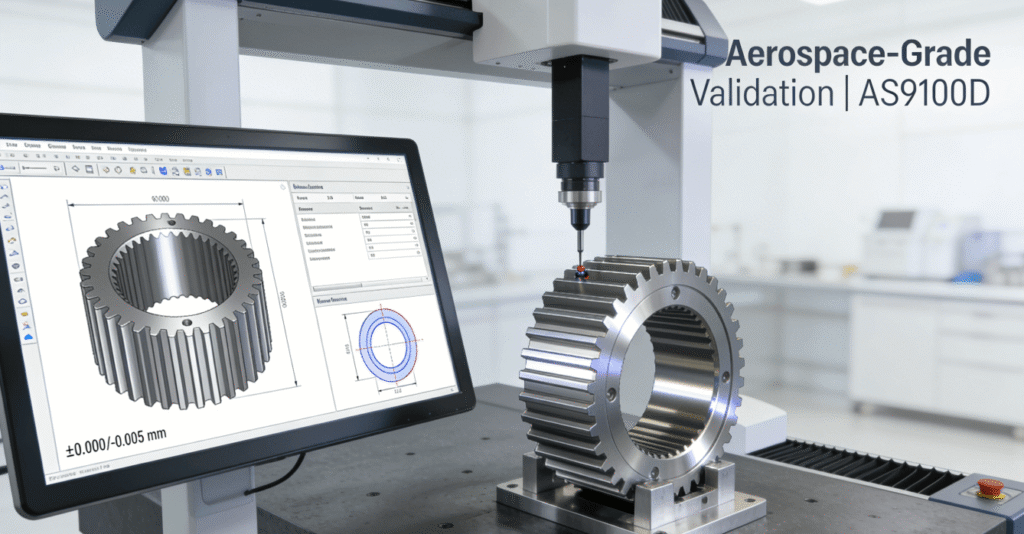
In the aerospace industry, the level of accuracy is taken to its absolute limits with the use of Custom Gear Bushings. The requirements in this regard call for bushings that exhibit exceptional ratios of strength to weight and exacting tolerances on dimensions and concentricit perpendicularity of geometry.
To satisfy such requirements, it is necessary to manufacture Custom CNC Machined Bushings with the help of 5-axis simultaneous machining centers. These centers allow machining of intricate geometries, such as internal splines, oil passages, and mounting holes, in one single operation. Compliance with standards like AS9100D is not optional in the aerospace industry.This aerospace quality management system ensures full material traceability, rigorous process control, and a documented “zero-defect” culture, providing OEMs with the ultimate assurance of part integrity and supply chain accountability.
In Mass Production of Millions, How is Consistent Fit Between Every Custom Pin and Bushing Ensured?
Achieving a consistent 5-10 micron clearance between Custom Made Pins And Bushings in high-volume production (millions of units) transcends the capability of traditional “first-article” inspection. It requires a fully integrated, digitally-controlled manufacturing ecosystem.
Sophisticated Custom Bushings CNC Machining Services for OEMs achieve this through closed-loop manufacturing systems. The manufacturing equipment is fitted with in-process probing and laser measurement technologies that provide information on critical parameters in real time. This information is directly used by the machinery to make automated corrections with a micron level precision for tool wear and thermal expansion. The whole process is controlled through the use of SPC charts.This level of relentless consistency is often governed by stringent quality frameworks like IATF 16949, the automotive quality standard, which is increasingly adopted by top-tier oem precision cnc machining services for any high-volume, precision-critical application. It is this systematic, data-driven approach that guarantees every single paired component fits perfectly, assembly after assembly.
From Medical to Semiconductor: What “Ultra-Precision” Solutions Do Bushing Applications in Special Industries Require?
Industries like medical and semiconductor manufacturing impose requirements far beyond standard mechanical precision. CNC Machining Services and Custom Bushing Manufacturers must provide holistic “ultra-precision” solutions.
H3:Stringent Requirements for Medical and Life Sciences
- Material and Biocompatibility
Bushings that will be used in surgical instruments have to be made of high-quality, biocompatible alloys (for example, 316L stainless steel). - Surface Finish and No Burrs
The absence of any burrs is not optional because it can cause unnecessary harm to tissues. Additionally, certain surface roughness parameters should be met for the best results in terms of the effectiveness of the surgical instrument.
Ultra-Clean Requirements for Semiconductor Production
Bushings used as components for vacuum chambers should demonstrate very low out gassing properties. Moreover, extreme cleanliness is essential since any contaminants might result in problems during operation. Vacuum baking or electrophishing are examples of techniques that might be necessary here.
Summary
In summary, for the year 2026, the limits to which the bushing can function well in practice cannot only be determined from the mechanical aspect alone, but rather it is now part of a systems engineering problem involving materials technology, thermodynamics, and even digital-based quality management. The trick to turning a detailed design into a functioning one is the choice of the right manufacturing partner, a company with ample knowledge of CNC machining, a full range of finishings, and an effective quality system embedded in its operations, like LS Manufacturing.
Your project might require you to rethink your manufacturing resources if it faces tough tolerance requirements, difficult materials, and certification problems. Performing a manufacturing feasibility study on your project may just solve that..
Author Bio
This article was contributed by an expert with over 15 years of experience in the precision manufacturing sector. Having served global leading OEMs, the author specializes in process solutions for complex structural components. The author’s team currently provides technical support to LS Manufacturing.
FAQs
Q1: How is dimensional consistency ensured for CNC machined bushings in high-volume production?
A: Consistency is achieved through integrated in-process probing and Statistical Process Control (SPC) systems. These systems monitor dimensions in real-time during machining and automatically compensate for tool wear, ensuring that tolerances remain stable within ±0.005mm, even across large production runs.
Q2: Are there any particular certifications which need to be taken into account when machining custom bushings for aerospace applications?
A: In addition to product certifications depending on the specific material, the manufacturing company should have the AS9100D Aerospace Quality Management System Certification. It assures total traceability, strict risk management, and “zero defects” philosophy throughout the entire manufacturing process.
Q3: How can deformation be avoided when machining long thin-walled steel bushings with high length/diameter ratio?
A: Deformation prevention entails special techniques in workholding and machining processes. Such methods involve the implementation of stress relief between rough machining and finishing operations, the application of low depth of cuts, and special fixturing of components to provide longitudinal support during machining and reduce vibrations.
Q4: How can a “zero-burr” state of finish be obtained when machining medical-grade stainless steel bushings?
A: The process of obtaining a “zero-burr” state consists of both optimized CNC programming and post-processing activities. The CNC program contains instructions that allow tool extraction from a surface without burr formation. In addition, post-processing procedures such as micro-abrasive flow machining (AFM) or electro-polishing may be used to remove micro-burrs.
Q5: In addition to pricing considerations, what factors should one consider in choosing a CNC machine processing partner?
A: Some critical factors to consider include technical problem-solving skills, quality control processes, and the industry experience of the partner. It is important to study whether the company has a history of operations certified for quality management using ISO 9001 and IATF 16949, as well as cases where similar technical problems have been successfully solved.